The infant sleep aid: Evidence-based tips for better baby sleep
© 2008-2018 Gwen Dewar, Ph.D., all rights reserved
Looking for an effective infant sleep aid?
Hither are 13 evidence-based tips for helping your baby fall comatose and stay asleep.
For more ideas, see these articles about opens in a new windowinfant sleep patterns and opens in a new windowsolving infant slumber problems.
ane. The bedtime routine: A helpful baby sleep aid with no apparent downside
Many sleep experts suggest that parents develop a regular bedtime routine for their infants. This might include about xx minutes of serenity, calming, low-key activities like
- bathing,
- reading a bedtime story,
- singing a lullaby, and
- giving the babe a gentle massage.
In theory, such bedtime rituals help babies wind downward, and brand the transition from waking to sleeping more pleasant.
In do, parents instructed to introduce bedtime routines have reported rapid improvements in sleep quality (Mindell et al 2017).
In that location is also evidence that certain components of a routine — similar babe massage — may be constructive in their own correct (come across below).
What if you endeavour this infant sleep aid, and detect that your baby still resists falling asleep?
Try delaying the bedtime routine until later at night (when your infant shows signs of drowsiness).
And then, if you lot desire your baby to notice an before bedtime, begin the routine a piddling bit before each night, until you reach your goal.
For more information, see this article on gentle methods of infant sleep preparation.
2. Babe massage: an infant sleep aid for reducing night wakings?
Although a variety of cultures practise baby massage, there has been little inquiry on its effectiveness an an baby sleep aid.
However, the express bear witness suggests that massage could aid.
In one report, researchers randomly assigned some mothers to introduce their babies (ranging from three to 18 months in historic period) to a massage-based bedtime routine. The intervention didn't make babies autumn asleep whatever faster, but it seemed to help in other ways.
Afterwards 2 weeks, mothers reported that bedtime had become easier, and their babies experienced fewer opens in a new windownighttime wakings. Mothers in a command group experienced no such improvements (Mindell et al 2018).
In another report, babies who received 14 days of massage therapy (beginning in the second week of life) seemed to suit more quickly to the natural rhythms of day and night (Ferber 2002).
three. Pare-to-skin contact equally an infant slumber help
In modern-day hunter-gatherer societies, babies are frequently carried in slings against their mothers' naked skin. They also sleep with their mothers at dark (Konner 2007).
As a result, these babies get lots of skin-to-skin contact. Does this contact function as an infant sleep help?
Scientific studies of Western infants show that skin-to-skin contact, as well known as "kangaroo care," has a painkilling effect on babies (Gray et al 2000).
Information technology is as well likely to boost an babe'south levels of oxytocin, a hormone with allaying effects (Uvnas-Moberg 2003).
And skin-to-skin contact appears to help premature babies calm down. In 1 study, kangaroo intendance reduced agitation, rapid heart charge per unit and apnea in preterm infants (Messmer et al 1997).
So it seems plausible that giving babies a picayune kangaroo care before bedtime might help them slumber better. Simply as of June 2018, I can find no randomized, controlled studies testing this idea. Researchers take begun one such study (Cooijmans et al 2017); we may learn the outcome soon.
4. Swaddling tin be a helpful babe slumber aid — simply be sure to follow prophylactic guidelines
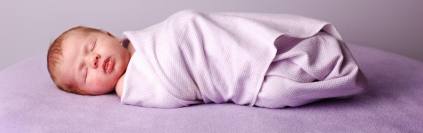
Swaddled babies are wrapped in cloths or blankets that restrict movement. Equally a outcome, they are less likely to thrash around during the frequent startles that back-trail infant sleep. Does that assistance babies stay asleep? Research supports the thought.
In 3 different experiments, infants who were swaddled and place on their backs showed improvements in sleep. They experienced fewer startles, awoke less often, and spent more than fourth dimension sleeping (Gerard et al 2002; Franco et al 2005; Meyer and Erler 2001).
So swaddling can be an effective infant sleep help. But it tin also exist unsafe, so it's crucial to follow safety guidelines.
It'southward important to avoid swaddling a baby'due south chest so tightly that he or she can't inhale deeply. Tight swaddling has been linked with higher rates of respiratory infections.
In addition, at that place is a potential for overheating, particularly if the baby's head is covered, or if the babe has a fever. And babies shouldn't be wrapped so tightly that they tin't rotate their hips and flex their knees. Immobilizing babies in this way puts them at risk for hip displasia.
Finally, there is evidence that swaddling tin increase the take a chance of SIDS, or sudden infant decease syndrome.
Studies show that SIDS victims are more likely to accept been swaddled. The highest risk is associated with swaddled babies who are placed on their stomachs. Babies placed on their sides or backs seem to exist at less gamble, but the risk is nonetheless there, peradventure considering some babies manage to move onto their stomachs (Pease et al 2016).
For this reason, experts recommend that you always place swaddled babies on their backs (the least risky position), and stop swaddling altogether once babies appear capable of turning themselves over (Pease et al 2016).
So overall, it seems to boil down to this:
- don't wrap babies tightly
- don't cover their heads, or otherwise let babies get overheated
- don't constrict the hips or prevent babies from bending their knees, and
- make sure that swaddled babies remains on their backs.
For tips on safe swaddling, picket this instructional video.
5. Daytime light exposure as an babe sleep help
You might not recall of a walk in the sunlight as an baby sleep help. But it could help your baby better at night.
Why?
It's because of your infant's internal circadian rhythms — physiological cycles that repeat over an approximately 24-hour period. When babies are built-in, these internal rhythms aren't synchronized with the rhythms of the external, 24-hour mean solar day (Rikvees 2003). As a consequence, babies tin wake and sleep at odd times — and wear u.s.a. out.
Simply nosotros can assist babies make it sync by providing them with strong daytime cues — exposing them to natural lite during the solar day, and including them in our daytime activities. Both tactics are associated with faster synchronization (Thomas et al 2016; Harrison 2004; Wulff and Siegmund 2002).
half dozen. Avoiding nighttime light — peculiarly the blue wavelengths.
Research confirms that calorie-free exposure at night sends a powerful, sleep-busting bespeak to the brain: Stay alert. Delay the release of the hormone, melatonin, that facilitates relaxation and drowsiness.
As I annotation in this article, young children may be especially sensitive to the slumber-busting effects of artificial lighting, and the bluish wavelengths may have the most confusing effects.
Then in the evenings, shift to dim lighting. Endeavour to protect your baby from light exposure in the middle of the night. And utilise light bulbs and blue-light filters that are designed to block the blue wavelengths that are particularly probable to crusade sleep disruption.
7. Baby sound machines and white racket: Potentially effective — but be careful well-nigh keeping the volume low
A number of toys and electronic devices are marketed equally "baby slumber soothers" or "baby sound machines." These typically emit white noise. Practise they actually help babies snooze?
There's reason to think so. For example, in an experimental written report of newborns, 80% of infants assigned to hear playbacks of white noise fell asleep spontaneously within five minutes. Only 25% of control infants fell asleep spontaneously (Spencer et al 1990).
But it's crucial to keep the volume turned downward, specially if the machine is placed close to the babe. You don't desire to harm your baby'due south hearing.
When researchers investigated xiv different white dissonance machines being marketed for infants, they found that all of them could be turned up to dangerously high volumes — volumes that would expose an infant xxx cm away to more than than 50 decibels.
And three of the machines at this altitude produced sound in backlog of 80 decibels — enough, when exposed for more than than 8 hours a solar day, to put an adult at run a risk for hearing loss (Hugh et al 2014).
This might sound like a major spoiler. What's the point of using a white noise automobile if you lot can't turn up the volume high plenty blot out other sounds?
But I suspect that'south the wrong premise. We don't need to blot out all background sounds in order to aid sleep. Instead, certain types of muffled, rhythmic sound may influence sleep past encouraging the brain to prefer or maintain the slower, rhythmic brain waves associated with sleep (Bellesi et al 2014; Papalambros et al 2017).
If this is the case, so soothing sounds played at a moderate, safety book may assist babies slumber — even if other noises can be heard as well.
viii. The pacifier: No compelling evidence that it helps babies slumber

Is the pacifier an effective slumber aid? The evidence is inconclusive at best.
Yeah, in that location is reason to think that pacifiers soothe babies. When babies are subjected to painful medical procedures (similar a heel prick to depict blood), sucking on a pacifier appears to reduce their perception of hurting (Campos 1994; Blass and Watt 1999).
But there's a grab: The pain-reducing result seems to work only as long as the babe is actually sucking on the pacifier (Campos 1994).
That could be a trouble when information technology comes to using a pacifier as a sleep aid. When the pacifier falls out of the baby's mouth, the soothing effect ends. And the pacifier will fall out of the infant'due south oral cavity.
In a written report that recorded the slumber patterns of babies aged 6-18 weeks, almost two-thirds of infants lost their pacifiers within thirty minutes of falling asleep (Franco et al 2004).
Perhaps that's why researchers accept failed to turn up show that pacifiers make a difference for infant sleep. In ane survey, researchers found that babies who sucked on their ain thumbs or fingers slept longer at night, and experienced few night wakings.
Past contrast, babies who used pacifiers showed no such such advantages. Their outcomes were similar to those of babies who didn't suck on anything at all (Butler et al 2016).
Are there any other benefits to sucking on a pacifier at night? It's possible that pacifier apply might reduce an infant'south gamble for sudden baby decease syndrome, or SIDS. I study reports that infants who use pacifiers arouse more easily to disruptive sounds — and the tendency to arouse quickly is by and large protective confronting SIDS (Franco et al 2000).
But we're currently lacking the sort of rigorous studies that might confirm this issue. When researchers reviewed the published inquiry, they could detect no randomized, controlled studies testing the effectiveness of pacifiers for the reduction of SIDS adventure (Butler et al 2016).
ix. Rocking babies to sleep: Weighing the costs and benefits
Is rocking an effective infant sleep assistance? Information technology might piece of work well for some babies. But parents should consider ii potential problems.
The commencement is that rocking a baby in your artillery might actually be too stimulating (French republic and Blampied 1999).
For example, in a report that monitored newborns during a painful medical procedure (the heel prick described above), babies were either (i) held and rocked, or (ii) given a pacifier to suck.
Compared with the babies given a pacifier, the infants who were rocked showed reduced rates of crying. But they were more likely to remain awake and alert (Campos 1994).
The other potential trouble concerns rocking babies to sleep in cradles. Cradle-rocking is a widely adept babe sleep aid, and many parents report that it helps babies fall asleep. But some sleep researchers are concerned that babies volition come up to associate falling asleep with being rocked in the cradle.
As a effect, when these babies experience arousals during the night (equally all babies do) they won't be able to go back to sleep without beingness rocked again. So they wake all the way upwards and cry for aid.
Although this sounds very plausible, I haven't found experimental support for this merits. However, a survey of Thai baby slumber patterns has reported that infants who sleep in swinging or rocking cradles are more than likely to feel frequent night wakings (Anuntaseree et al 2007).
ten. Lavander equally an infant sleep assist: Does information technology work?
You might have seen claims that lavender oil is an effective babe sleep help. What does the prove really say?
A number of studies have shown that people exposed to the aroma of lavender experience more relaxed and spend a greater percentage of time in deep sleep (e.g., Goel et al 2005).
There is also a study reporting that mothers who bathed their young infants in water scented with lavander-scented bath oil experienced benefits (Field et al 2007).
The mothers became more relaxed, touched their infants more than frequently, and smiled at their infants more than oftentimes. The infants, in turn, looked at their mothers more. They cried less often, and spent more than fourth dimension in deep sleep after the bathroom. Both mothers and infants showed reduced levels of cortisol (the stress hormone) after bath-time.
These results make lavender sound like a helpful infant sleep help, but it's non articulate that thelavender was directly responsible for the soothing effects.
A study published in the British Journal of Health Psychology tested the possibility that lavender aromatherapy works considering people like the smell and expect information technology to relax them (Hughes and Hughes 2008). Before exposing people to the scent of lavander, researchers either told them that lavender was relaxing or stimulating. The results showed that people became more or less relaxed as a function of what they were led to expect.
And so if lavender is an effective infant sleep aid, it might be considering the fragrance makes parents feel more relaxed — and more probable to acquit in ways that keep babies at-home.
Should yous use lavender-scented products? If you lot detect the scent soothing, it might be a good thought.
Simply at that place is reason to be cautious about applying lavender oil straight to your baby'south skin. Lavander oil contains estrogen-mimicking compounds, and in that location is some clinical evidence (based on three instance studies) suggesting that the topical application of lavender oil may cause chest growth in preadolescents (Henley et al 2007).
11. Toys and other comfort objects: Practise they promote better sleep?

Pillows, stuffed toys, blankets, and other soft objects can pose an asphyxiation hazard to babies nether 12 months of age. And then rubber experts urge that we go on such objects out of a immature infant's crib or cot.
But suppose y'all had a toy or other "condolement object" that didn't pose a risk. Are such items constructive infant sleep aids?
It might seem like a no-brainer if you grew up in certain Western countries. Giving condolement objects to slumber with is a common folk exercise — ane designed to assistance children fall asleep on their own.
But when researchers investigated the miracle in babies, they didn't notice whatever evidence that comfort objects have whatever discernible effect on an infant'due south ability to fall asleep independently.
The study tracked infants in four age groups (3, 6, 9 and 12-month olds) over a menses of 3 months (Burnham et al 2002).
Infants were videotaped in their own homes while they slept, and scored equally "self-soothing" if, subsequently awakening during the night, they managed to autumn back to slumber without parental intervention.
Researchers too noted where babies slept, and whether or not the babies touched, held or sucked on whatever objects during the night — objects that included pacifiers, toys, blankets, and the babies' own hands.
How did things turn out? Babies were more than probable to apply "comfort objects" if they were put to bed while still awake. And, overall, about 90% of babies used some sort of infant sleep aid, at least occasionally.
Only there was no significant correlation between self-soothing and using a condolement object.
Why not? Previous inquiry reported that comfort objects were helpful for a somewhat older group of infants (eight months and upward). So it'south possible that this is something that emerges naturally in some infants every bit they get older (Anders et al 1992; Burnham et al 2002). Meanwhile, it seems that that prophylactic concerns and sleep research point in the same diretion
12. Dream feeding: Does it aid babies sleep longer?
Dream feeding is the practise of "tanking up" your baby immediately before yous attempt to autumn asleep.
It's typically washed while the baby is already comatose, so it isn't intended as a method to aid babies fall asleep.
But it may help ensure that you get a bit more time to sleep before your baby awakens. And in this respect, dream feeding could exist a useful infant slumber aid for encouraging longer sleep bouts. Read more most it opens in a new windowin this Parenting Science article.
thirteen. Nursing a baby to slumber: The ultimate sleep aid?

Throughout human history, whether breastfed or bottle-bed, babies have been nursed to slumber. It is probably the most reliable infant sleep aid in existence.
Why is it so effective? To some caste, it's obvious. Hunger is an unpleasant awareness. Sate the hunger, and a infant is going to feel more than comfy and relaxed afterwards.
But there is more to information technology than that.
First, information technology isn't just a question of calories.Newborns cry less and seem to experience less hurting when they receive very small amounts of milk, formula, or sucrose (encounter review by Shaw et al 2007; besides Blass 1997a; Blass 1997b; Blass and Watt 1999; Barr et al 1999). Moreover, the act of sucking–even sucking a pacifier–has a calming event (Blass and Watt 1999).
Second, infants who breastfeed experience skin-to-skin contact, which may exist an constructive baby sleep assist in its own correct (see infant slumber assist #three).
In addition, breastfeeding boosts a mother's oxytocin levels, which tin raise her maternal feelings and impart a sense of calm (Keverne 1996). Such psychological changes may make it easier for her to soothe her baby.
In that location is as well the possibility that opens in a new windowbreastfeeding in the evening increases a infant's levels of melatonin, the hormone that helps us become drowsy (Cubero et al 2005).
Then feeding can be a powerful babe sleep help. Yet information technology is controversial. Why?
I reason concerns the question of timing.
Parents who use feeding every bit an baby slumber aid may tend to feed their infants more than often, and some researchers believe high-frequency feedings could interfere with the development of longer sleep bouts at night.
For example, 1 written report found that newborns who were fed frequently during the first week postpartum—more than than 11 times during each 24 hour menstruation—were 2.vii times more likely than were other infants to have bug at 12 weeks (Nikolopoulou and St James-Roberts 2003).
But research like this tin can't tell us if frequent feedings crusade sleep problems. It may be that some infants are needier than others, and that those who need to feed ofttimes during the kickoff week postpartum continue to need frequent night feedings afterwards on.
The other source of controversy concerns self-soothing.
Although feeding may be an effective infant sleep aid in the short-term, it might discourage babies from developing the ability to fall asleep on their own.
Western sleep researchers often suggest against letting babies fall comatose in their parents' arms. Instead, they recommend that babies be put to bed while withal awake. If babies cry, parents should resist the temptation to soothe them—at least for a few minutes.
By holding dorsum, parents will forcefulness babies to acquire their ain "self-soothing" skills, and babies will learn to autumn asleep by themselves. When babies experience arousals during the night, they volition soothe themselves back to sleep without awakening their parents (France and Blampied 1999; Ferber 2006).
There is strong evidence to support these claims. Babies who are put to bed earlier they fall asleep are indeed more probable to soothe themselves back to slumber when they awaken over again during the night (e.m., Anders 1979; Anders et al 1992; Ferber 1986; Goodlin-Jones et al 2001).
Simply does this mean you shouldn't allow your baby to fall asleep during a feeding? Perhaps not.
Feeding appears to exist a natural infant sleep aid, and soothing babies to sleep is the norm for our species. In many parts of the world, babies routinely autumn asleep at the breast, and their parents don't perceive this to exist a trouble.
Moreover, some researchers are concerned almost the physiological and psychological effects of strictly-imposed, lone sleep regimens. Typically, babies don't conform to such regimens without experiencing transitional distress. And even those who abet sleep training for babies warn that "cry it out" methods are inappropriate for babies less than half-dozen months (France and Blampied 1996; Owens et al 1999).
For more data, see my commodity near the near well-konwn regimen associated with "cry information technology out" methods — opens in a new windowthe Ferber method.
References: Finding the right infant sleep aid
American Academy of Pediatrics. 1997. Breastfeeding and the Utilize of Human Milk. Pediatrics 100 (6): 1035-1039.
Anders TF. 1979. Nighttime waking in infants during the first year of life. Pediatrics 63: 860-864.
Anders TF, Halpern LF, and Hua J. 1992. Sleeping through the night: A developmental perspective. Pediatrics xc(four): 554-560.
Anuntaseree W, Mo-Suwan L, Vasiknanonte P, Kuasirikul Due south, Ma-A-Lee A, and Choprapawan C. 2007. Night waking in Thai infants at 3 months of age: Association between parental practices and infant slumber. Slumber Med. 2007 Sep 25 [Epub ahead of print].
Barr RG, Pantel MS, Immature SN, Wright JH, Hendricks LA, Gravel R. 1999. The response of crying newborns to sucrose: is it a "sweetness" effect? Physiol. Behav 66: 409-417.
Bellesi M, Riedner BA, Garcia-Molina GN, Cirelli C, Tononi G. 2014. Enhancement of sleep tedious waves: underlying mechanisms and practical consequences. Front Syst Neurosci. 8:208.
Blass EM. 1997a Milk-induced hypoanalgesia in homo newborns. Pediatrics 99: 825-829.
Blass EM. 1997b. Babe formula quiets crying newborns. Journal of Dev Behavioral Pediatrics. 18:162-165.
Blass EM and Watt LB. 1999. Suckling- and sucrose-induced analgesia in homo newborns. Pain. 83(3):611-23.
Butler R, Moore M, Mindell JA. 2016. Pacifier Use, Finger Sucking, and Infant Sleep. Behav Sleep Med. 14(6):615-23.
Campos RG. 1994. Rocking and pacifier use: Ii comforting interventions for heel stick pain. Res Nurse Health 17: 321-331.
Cooijmans KHM, Beijers R, Rovers Air-conditioning, de Weerth C. 2017. Effectiveness of pare-to-peel contact versus care-as-usual in mothers and their full-term infants: written report protocol for a parallel-group randomized controlled trial. BMC Pediatr. 17(i):154.
Cubero J, Valero Five, Sánchez J, Rivero One thousand, Parvez H, Rodríguez AB, Barriga C. 2005. The circadian rhythm of tryptophan in breast milk affects the rhythms of 6-sulfatoxymelatonin and slumber in newborn. Neuro Endocrinol Lett. 26(6):657-61.
Cubero J, Narciso D, Terrón P, Rial R, Esteban S, Rivero Thousand, Parvez H, Rodríguez AB, Barriga C. 2007. Chrononutrition practical to formula milks to consolidate infants' sleep/wake bike. Neuro Endocrinol Lett. 28(4):360-vi.
Ferber R. 1986. Sleepless child. In: C. Guilleminault (ed), Slumber and its disorders in children. New York: Raven Press, pp. 1410163.
Ferber R. 2006. Solving your child'due south sleep problems: New, revised, and expanded edition. New York: Fireside.
Ferber SG, Laudon Chiliad, Kuint J, Weller A, and Zisapel N. 2002. Massage therapy past mothers enhances the adjustment of cyclic rhythms to the nocturnal period in full-term infants. J Dev Behav Pediatr. 23(6):410-5.
Field T, Field T, Cullen C, Largie Due south, Diego 1000, Schanberg S, Kuhn C. 2007. Lavender bath oil reduces stress and crying and enhances sleep in very young infants. Early Hum Dev. 2007 November 27 [Epub ahead of print]
France KG. 1992. Beliefs characteristics and security in sleep disturbed infants treated with extinction. J Pediat Psychol 17: 467-475.
French republic KG and Blampied NM. 1999. Infant sleep disturbance: Description of a problem behaviour procedure. Sleep Medicine Reviews 3(four): 265-280.
Franco P, Scaillet S, Wemenbol V, Valente F, Grosswasser J, and Kahn A. 2000. The influence of a pacifier on infants' arousals from slumber. J Pediatr 136: 775-779.
Franco P, Chabanski S, Scaillet S, Groswasser J, and Kahn A. 2004. Pacifier employ modifies infant's cardiac autonomic controls during slumber. Early on Hum Dev. 77(1-2):99-108.
Franco P, Seret N, van Hees JN, Scaillet S, Groswasser J and Kahn A. 2005. Influence of swaddling on sleep and arousal characteristics of good for you infants. Pediatrics 115: 1307-1311.
Gaddini R. 1970. Transitional objects and the process of individuation: a study during the get-go year of life. J Am Acad Child Psychiatry 9: 347-365.
Goel Northward, Kim H, and Lao RP. An olfactory stimulus modifies nighttime sleep in immature men and women. Chronobiol Int. 2005;22(v):889-904.
Goodlin-Jones BL, Eiben LA, and Anders TF. 1997. Maternal well-being and slumber-wake behaviors in infants: An intervention using maternal odor. Infant Mental Health Journal. eighteen:378–393.
Goodlin-Jones BL, Burnham MM, Gaylor EE, and Anders TF. 2001. Night-waking, slumber organisation, and self-soothing in the starting time year of life. J Dev Behav Pediatrics 224(6): 226-233.
Gray 50, Miller LW, Philipp BL, Blass EM. 2002. Breastfeeding is analgesic in healthy newborns. Pediatrics 109: 590-593.
Gray L, Watt L, and Blass EM. 2000. Pare-to-pare contact is analgesic in healthy newborns. Pediatrics 105(one): e14–e24.
Harrison Y. 2004. The relationship betwixt daytime exposure to light and nighttime-time slumber in 6-12-week-old infants. J Sleep Res. thirteen(4):345-52.
Henley DV, Lipson N, Korach KS, and Bloch CA. 2007. Prepubertal gynecomastia linked to lavender and tea tree oils. New England Journal of Medicine 356(5):479-85.
Hong KM and Townes BD. 1976. Infants' attachment to inanimate objects. J Am Acad Kid Psychiatry. 15: 49-61.
Howard Southward and Hughes BM. 2008. Expectancies, not aroma, explain bear on of lavender aromatherapy on psychophysiological indices of relaxation in young healthy women. Br J Wellness Psychol. 13(Pt 4):603-17.
Hugh SC, Wolter NE, Propst EJ, Gordon KA, Cushing SL, Papsin BC. 2014. Infant sleep machines and hazardous sound pressure levels. Pediatrics. 133(4):677-81.
Jenni OG and O'Connor BB. 2005. Children's sleep: An interplay between civilization and biology. Pediatrics 115: 204-215.
Karakoç A and Türker F. 2014. Effects of White Noise and Holding on Pain Perception in Newborns. Pain Manag Nurs. 2022 Feb 19. pii: S1524-9042(fourteen)00023-X. [Epub ahead of print]
Keverne EB. 1996. Psychopharmacology of maternal behavior. J Psychopharmacol. 10:16-22.
Konner M. 2005. Hunter-gatherer infancy and childhood: The !Kung and others. In: Hunter-gatherer childhoods: Evolutionary, developmental and cultural perpectives. BS Hewlett and ME Lamb (eds). New Brunswick: Transaction Publishers.
Messmer PR, Rodriguez Due south, Adams J, Wells-Gentry J, Washburn K, Zabaleta I, and Abreu S. 1997. Event of kangaroo intendance on sleep fourth dimension for neonates. Pediatr Nurs. 23(4):408-fourteen.
Mindell JA, Lee CI, Leichman ES, Rotella KN. 2018. Massage-based bedtime routine: touch on sleep and mood in infants and mothers. Slumber Med. 41:51-57
Mindell JA, Leichman ES, Lee C, Williamson AA, Walters RM. 2017. Implementation of a nightly bedtime routine: How chop-chop do things amend? Infant Behav Dev. 49:220-227.
Nikolopoulou M and St James-Roberts I. 2003. Preventing sleeping issues in infants who are at risk of developing them. Arch. Dis. Kid. 88: 108 – 111.
Owens JL, France KG, and Wiggs L. 1999. Behavioural and cognitive-behavioural interventions for sleep disorders in infants and children: A review. Slumber Medicine Reviews 3(4): 281-302.
Papalambros NA, Santostasi One thousand, Malkani RG, Braun R, Weintraub S, Paller KA, Zee PC. 2017. Audio-visual Enhancement of Sleep Slow Oscillations and Concomitant Memory Improvement in Older Adults. Front Hum Neurosci. 11:109.
Pease AS, Fleming PJ, Hauck FR, Moon RY, Horne RSC, et al. 2016. opens in a new windowSwaddling and the Risk of Sudden Infant Death Syndrome: A Meta-analysis. Pediatrics DOI: x.1542/peds.2015-3275
Pinilla T and Birch LL. 1993. Help me make information technology through the night: Behavioral entrainment of breasfed infants' sleep patterns. Pediatrics 91: 436-444.
Rikvees SA. 2003. Developing circadian rhythmicity in infants. Pediatrics 112: 373-381.Shah PS, Aliwalas Fifty, and Shah V. 2007. Breastfeeding or breast milk to alleviate procedural pain in neonates: a systematic review. Breastfeeding medicine 2:74-82.
Spencer JA, Moran DJ, Lee A, Talbert D. 1990. White noise and sleep consecration.Arch Dis Child. 65(one):135-7.
Thomas KA, Burr RL, Spieker S. 2016. Light and maternal influence in the entrainment of activity circadian rhythm in infants 4-12 weeks of age. Sleep Biol Rhythms. 14(3):249-255.
Uvnas-Moberg One thousand. 2003. The oxytocin cistron: Borer the hormone of calm, honey and healing. Cambridge, MA: De Capo Press.
The World Health Arrangement, 1998. Postpartum care for mother and newborn: report of a technical working group.
Van Sleuwen BE, Engleberts AC, Boere-Boonekamp MM, Kuis W, Schulpen TW, and L'Hoir MP. 2007. Swaddling: A systematic review. Pediatrics 120(4): e1097-e1106.
Wulff Thousand, Dedek A, Siegmund R. 2001. Circadian and ultradian time patterns in human behavior: Part 2: Social synchornization during the evolution of the baby's diurnal activity-balance pattern. Biological Rhythm Research. 32(v):529–46.
Content of "The baby sleep help: An bear witness based guide for getting your baby to sleep" terminal modified 5/2018
Prototype credits for "The baby slumber aid"
Title image of female parent shushing viewer / istock
prototype of swaddled infant past istock
prototype of infant grasping blanket past opens in a new windowMatthew Romack/flickr
thompsonhattp1998.blogspot.com
Source: https://parentingscience.com/infant-sleep-aid/

Post a Comment for "The infant sleep aid: Evidence-based tips for better baby sleep"